Wednesday, November 13, 2013

In the central Philippines, a humanitarian crisis, on Facebook, TROLLS!


NOW the Danish news is focused on the humanitarian crisis in Tacloban, Leyte, and the rest of the Philippines: the delay in receipt of food, water and medicine on the ground, despite the loads of aid arriving from foreign countries. DR (Denmark's state television) has three reporters as of today in my country.

Philip Khakhar, normally assigned to Afghanistan, filed his report from Cebu, the afternoon of November 13. The death of eight people in a panicked stampede at a store or warehouse came up, Khakhar quoting a witness who said the looters were not criminals nor professionals, just ordinary citizens who were starving.

He mentions President Aquino's statement that the actual death toll was closer to 2,000 - 2,5000 instead of 10,000, adding that it sounded like an attempt to downplay the extent of the damage in the face of a storm of criticism of the government.

In the second part of the report, Danish Red Cross director Anders Laderkarl is interviewed via Skype from Manila, speaking of the logistical challenge of getting help out to those who need it.

I don't have a direct link to this report but here's a link to DR's news menu as of today, November 13: http://www.dr.dk/nyheder/

(Sorry, it's in Danish: my loose summary is the best I can do at the moment).


***

For the first time in five days I've gotten away from my computer, to which I'd been glued relentlessly reading through the updates on Facebook. Today the anger and frustration have escalated into full-scale arguments among my roster of friends and connections, most of whom have ties with the Philippines if not actually living there.
 
There are the usual conspiracy theorists, alternating criticism and defense of the Philippine government (especially those involved in getting aid to the victims of typhoon Haiyan), and, perhaps not surprisingly, a return to the cutesy forwarded bull --- blah invited you to play blah, blah likes a page, blah has uploaded a food-porn shot as she was wont to do pre-typhoon -- that makes me want to throw the portable phone at my computer screen (not advisable, not advisable at all).

And of course, there are the trolls, the many-striped Philippine and the common North American variety, slinking around to feed with ever-growing confidence and to spread their foul leavings over the internet. Whether it's disgruntlement at the defeat of a political patron, or righteous confidence in the proximity of the Rapture, or a just-plain-racist conviction that Filipinos ought to be sterilized out of existence, trolls take pleasure in rudeness and playing on the emotions of their victims. Fortunately, their grunts and howls are easily detectable, and solved with a simple click on the cursor.

In short, things on Facebook are getting back to normal. People who, like me, were glued to their computers over the weekend up until Tuesday, are now numbed by what had once been gruesomely riveting: ships' bows rearing up over the splinters of a house, cars stacked on top of each other like mating wildlife, a vista of what had once been middle class neighborhoods lying like a heap of matches, pretty facades standing alone like faces in a war zone, faces with everything else in back of them blown away.

Grotesquely, only the dead bodies have really changed in the now well-documented wasteland of Tacloban, lying bloated and black on sidewalks.

But I'm still sitting in front of my monitor, waiting for word from the rest of the afflicted provinces. Guiuan, Ormoc, Bantayan, Capiz, Antique ... what is the news?


Areas in Central Visayas, Philippines struggle for survival after Haiyan


Last night, I saw images of the damage on Bantayan island, Cebu, Philippines for the first time since the storm struck. This was on DR's (Danish television) nightly news program, where the Philippines remains the top international story. DR flew in two reporters to Cebu province.

Heartbreaking ... children and adults lined up by the roadside, reaching out with bare hands to the vehicle bearing the camera, a girl of about six supporting a hand-lettered HELP sign. No electricity. No refrigeration, no sewer service, and no mobile phones nor internet to let the outside world know.

The attention of the world has been on Tacloban, a thriving city of some 120,000 inhabitants and the capital of Leyte, because Tacloban was one of the first areas reached by disaster teams. But there are so many other parts of the central Visayas that need help. These images need to get out, be shared, too.

Here is a link to the news story (in Danish). Above photo is a screen grab from the same story.

http://www.dr.dk/Nyheder/Udland/2013/11/12/205356.htm


Tacloban - before and after typhoon Haiyan


Australia's ABC net has posted a series of satellite photos showing the once-thriving town of Tacloban, Leyte, Philippines, almost entirely devastated by Typhoon Haiyan. Roll your mouse over each image to see neighborhoods in Tacloban before, and after.

http://www.abc.net.au/news/specials/typhoon-haiyan-photos-before-after/

Screen shot is from abc.net.au.

Friday, November 08, 2013

A quick look at books for children in the Philippines today

 
by Lakambini A. Sitoy

 
This article was translated into Swedish and published in Opsis, a magazine devoted to children's literature, from of the Swedish Board on Books for Young People.
 
THE stereotypical view of Philippine life is of a hand-to-mouth existence, where people have neither the resources to buy books, nor the mental space to read. This is untrue: the country has a flourishing book industry, with a dynamic children’s book industry.

There are over 10 publishing houses specializing in, or with a branch dedicated to, children’s books. These include Adarna House, which put out Naku naku nakuuu! (published in Swedish by Förlaget Trasten, 2013, and winner of the 2013 SBBY Peter Pan Prize), Tahanan Books, Lampara, Anvil, the University of the Philippines Press, and Giraffe. On certain occasions, private organizations, of commercial, religious or charitable orientation, may publish children’s books as well. Their collective output encompasses picture books in full color, storybooks with illustrations in either full color or black and white, novels and chapter-books for young adults, anthologies, and even stationery featuring the artwork/illustrations.

Myths, legends and fables remain a popular subject, as do personified animal stories and myth-like tales written by contemporary authors. Ever popular are series featuring national heroes and statements, most connected with the independence movement of 1898. At least one publishing house, Lampara, puts out abridged versions of British classics, in English, with new illustrations. Yet many titles deal with everyday life and its conundrums and rites of passage, and a few address difficult topics like death, child abuse, bullying, parents who must work abroad, and indigenous peoples.

The books range in price from about P 70 for storybooks, to P600 and even more. P70 will buy a meal and soft drink at a fast-food franchise, or a flimsy t-shirt, or some 5 minutes talk time on a prepaid mobile phone card. The minimum wage for office workers in the Metro Manila area is about P450 per day; however, Philippine children’s books are usually purchased by professionals who earn much more than this, i.e. with dual middle-class to upper-middle class incomes.

Incentives for writers come in the form of contests, such as the annual Carlos Palanca Memorial Awards, which has a “story for children” category in both English and Filipino, and the Philippine Board on Books for Young People’s Salanga Prize. Universities with creative writing programs frequently offer a course on writing for children. Fine Arts or design students at university may specialize in children’s book illustration, submitting a mock-up of a book as thesis. The PBBY also awards an annual Alcala Illustrator’s Prize, and the National Children’s Book Awards (with the National Book Development Board). Ang INK is an organization of illustrators for children that puts up local exhibits and is active on-line. Illustrators nowadays tend to be young, well-trained and happy to experiment with new media and styles.

The Philippine government has also offered publishers incentives, such as the Library Hub, which has purchased hundreds of thousands of books from local publishers, for the use of children all over the country, including those residing in remote barrios(villages).

Language issues

In a country with two official languages – English and Filipino – as well as several regional languages, bilingualism (and tri- and multi-lingualism) is the rule rather than the exception.

It is not unusual to find picture books and storybooks with the text in both languages, printed next to each other, as with Adarna House’s titles – whatever the language of the original text, it appears with a translation.

Otherwise, the text may be in English or Filipino. Most mysteries or chapter books are written and published in English, as are storybooks with longer text. Rare is the trilingual picture book, or for that matter, text in the regional languages such as Cebuano or Hiligaynon.

There is a sense that Filipino, and the Tagalog language on which it is based, is a language under threat and must be nurtured by providing literary models of the best possible sort. It is also viewed as the first language of many Filipinos and thus, the best way to reach them at a young age. Yet English is privileged in the country, owing to its associations with cosmopolitanism and better job opportunities abroad as well as at home.

Reni Roxas, publisher of Tahanan Books, explains why the house began, some five years ago, to introduce Filipino or bilingual titles into what had been an all-English inventory: “First, the demand for vernacular books is fueled by the quest of a developing country still in search of itself. Second, Filipino families living abroad are enjoying renewed interest in the Filipino language. … Filipino-Americans who grew up in households where learning the mother tongue was de-prioritized in favor of cultural assimilation into the host country, now regret not having learned the language of their parents. They now want to teach Filipino to their children.”

Competition

The greater challenge, however, is how to grab a share of a market dominated by foreign books, which are readily available brand new all over the country, as well as from secondhand bookstores/ shops. In the latter, stocked mostly with rapidly-replenished inventory from the United States, books for children can be had for as little as 10 pesos. The ready availability of material at every price point is good for Filipino children’s reading habits, but puts local publishers at a disadvantage, with parents preferring to put their money on international super-sellers like the Harry Potter series, or Disney.

As with the rest of the world, Filipino children devote considerable attention to television, computers, mobile phones and, among higher income families, newer digital devices such as iPads or smart phones. These are valued for the entertainment they provide and as learning tools that augment what goes on in the classroom.

Even without the competition from electronic devices, the children’s book industry must reckon with the priority given to textbooks in a family’s budget. This is not surprising, in a culture that puts a premium on education, and where enrollment at the better schools is neither free, nor even subsidized. ***

Monday, October 21, 2013

Perfume oils in my collection

Coming soon: thoughts and images from my trip to China, and the earlier trip to Greece, and from the Gothenburg book fair, where I met three wonderful Filipino colleagues.
 
But first, some text that I already have on hand. I'm beginning to notice that, every time I think to update this blog with something I've already written, it turns out to be some frivolous stuff about perfume. Testing new perfumes and writing reviews about them is a great hobby -- something I devote more hours to that I'm willing to admit. In Scandinavia it's also a bit of a vice -- the culture here could even be described as anti-perfume, with "fragrance free" being the selling point for loads of bodycare products and makeup. I hardly wear perfume when I go out, for this reason.
 
Anyway, the perfume aficionado website to which I belong has a message board. Here there's been a slew of posts about perfume oils, how long they last compared to alcohol-based fragrances, how best to apply them, and how they smell. There's a whole range of perfume oils from the Middle East and India, where the use of alcohol in products is unpopular for religious and/or cultural reasons. Western-leaning perfumistas are only just discovering them. 

The chief attraction -- to me, at least -- is that they smell weird.  They are lush and over-the-top. Many of them have oud (synthetic in the cheapest), a component that Western designers are just discovering and exploiting. I'm one to be intrigued and excited by strangeness, and to me the strangest of all is that the same heavily floral- oriental- woody perfume is marketed to men as well as women.

My own experience with perfume oils is modest. Last year I bought a score of 6ml roll-ons from al-Rehab, and added to my collection of "inspired-by" oils available on a British website (which, by the way, thanks to tighter Royal Mail rules, no longer ships outside the UK, so that's the end of collecting for me). Here, some reviews of a few of the al-Rehabs in my collection, for those who may be interested in this brand. Their products sell for very little, by the way.

Now, my reviews.


It is a light floral fragrance (mainly a transparent sort of rose) overlaid with some very disconcerting and very pronounced synthetic oud. I associate oud with heavy, sweet, woody or ambery scents, so the treatment is quite different here. The oud is the first thing you smell, even from the bottle, and it remains a definite presence the entire time the fragrance lasts, even though the rose eventually takes the fore. An acquired taste. Just outside the borders of my comfort zone, but I wouldn't mind my closet smelling like this, with the scent lingering on my clothes. EDIT: This lasts quite a while. After washing my hands, I could still smell the somewhat lemony rose, but not the oud.

Wednesday, September 18, 2013

"Tower of Babel" poetry and prose reading in Copenhagen


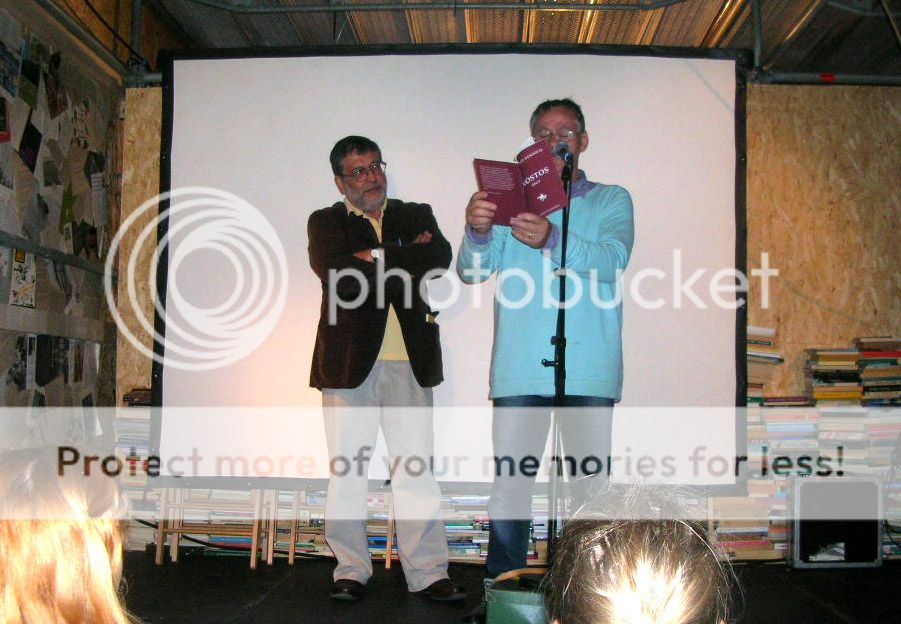
I am sharing some photographs from the Tower of Babel poetry and prose reading (September 5), part of the Images Festival held in Copenhagen recently.
 
The organizers of the festival had set up a temporary structure, long and rectangular like a shipping container, on one side of Dronning Louise's Bridge in central Copenhagen. There were booths containing various exhibits; the  Ord og Debat (Word and Debate) booth was where the reading was held.
 
The roof of the structure was a platform where people could hang out and party and we could hear various thumps and bangs all evening. The Ord og Debat booth was a sight to behold, decorated floor-to-ceiling with yellowed books, their pages pleated, crumpled, folded and slashed to produce texture on texture: an ironic statement on the physical beauty of paper, the irreverence of creativity and the ultimate irrelevance of content. It was "text transformation" on the totally material level, invoking fillips of delight and dread in bibliophiles like myself.
 
Later I found out that the booth's decoration was a joint effort of some of the authors who had been invited to participate in some of the activities at the Festival!
 
That evening, however, the word was audible: text turned to speech and voice. Most of us brought samples of our published work  to read from or show to the audience (I took the opportunity to plug the French translation of Sweet Haven), although suppose with the unspoken hope that our books would remain happily intact and, unlike the books that decorated the walls, agape on account of being read.

***
 
I took lots of pictures, but ironically, have none of myself reading. If someone has a pic of me overcoming my chest cold to read the opening pages of Sweet Haven that evening, please send me an email! Muchas gracias in advance.


 Eye-popping decor


The little stage. Intimate, no?
 
 
The participants


 A chest of books, literally, showing the work of some of the authors who read that evening. Interesting table legs.
 
 
Danish poet and travel writer Thomas Boberg
 
 
 Bolivian poet and educator (and our houseguest later that week) Jessica Freudenthal Ovando
 

Indian novelist Mridula Koshy and Korridor proprietor/Tower of Babel organizer Simon Kristensen

 Malawi author Shadreck Chikoti
 
Peruvian poet and translator Renato Sandoval (left) with the Danish translator of his work. 

 Danish writer Stine Bork Kristensen
 
 Hungarian composer and musician Krisztina Vas


Dronning Louises Bridge in Copenhagen, where temporary booths had been set up to house various events making up the Images: Occupy Utopia Festival.
 
It was dark by the time we were done, which gave me a chance to finally capture a cityscape (or lake-scape) I've seen so many times before, heading home from visiting friends in the city.

Saturday, August 17, 2013

Reading my fiction in Copenhagen

I will be reading an excerpt of my fiction along with other writers--visiting and Denmark-based -- at an event called Tower of Babel, Thursday, September 4, from 7 pm on to midnight, onstage at Dronning Louises Bro. This is a part of the Images Festival which opens in Copenhagen the weekend before.

Here are a few words from Simon Kristensen, the organizer, explaining the set-up:

"Tower of Babel finder sted i Kbh torsdag d. 5. sep. ml 19-24 på en scene på Dronning Louises Bro. Konceptet er korte oplæsninger (5-10 min.) hvor hver forfatter/poet læser op på originalsprog samt hvis muligt på dansk eller engelsk (selvfølgelig forudsat at originalsproget ikke er dansk eller engelsk). Afhængig af hvor mange vi bliver vil hver forfatter læse op 2-3 gange i løbet af aftenen. Tanken med aftenen er selvfølgelig også – udover spændende oplæsninger – at skabe et forum hvor forfattere og publikum kan mødes og indgå i forhåbentlig interessante samtaler."

Sorry, no English translation at the moment (that’s on my to-do list), but with a few clicks and crossed fingers, you can get an idea of it through Google Translate.

Will keep you all posted!


Teaching basic Filipino to Danish students this fall


Am looking forward to the fall term, which for me starts on Wednesday, 4 September. That’s when my class in basic Filipino at Studieskolen (Gothersgade 12, 1300 København K) meets for the first time. We had a great spring term with some very dedicated students, and I am eagerly anticipating the arrival of new faces – and the great diversity that such a class involves.

Medium of instruction will primarily be English, though students are of course free to express themselves in Danish, and there will be Danish translations as needed.

And as for my lovely students last term, I’m hoping to see some of them again in Filipino II, which is also being offered this fall. Filipino I is not a pre-requisite, so if you are in Denmark right now, and feel you know the basics of this extremely-flexible Malayo-Polynesian language, then feel free to sign up. In Filipino I last spring, we managed to string sentences while avoiding verbs (yes, it’s possible!) but this time, in Filipino II, we’re going to see some action!

Do contact Stine Hejlesen, tlf. 33 18 79 37, andresprog@studieskolen.dkfor more information.


Friday, June 14, 2013

Scandinavian language lesson, 1

One of the friends I made on-line, a Filipino nurse in Norway, commented on the seeming illogic of Norwegian idiom here:
The web post invites us to puzzle over the expressions
"tørr bak i øret" , literally "dry behind the ears", but meaning "of advanced years"
"holde i sjakk", literally "keep in check" but meaning to keep under control
"svart i øye", literally "black in the eye", but meaning in a rage
I don't know Norwegian, but perceive the similarities with English, apart of course from the grammar and structure of the words.
English has an expression "wet behind the ears" which means very young, newborn in fact. The reference is to the amniotic fluid that covers newborn puppies, foals, etc. The mother usually licks them "dry" with her tongue, removing all the birth gunk and allowing the clean saliva to dry off naturally. I can see how this expression might have originated in a culture where farming and keeping livestock played a major part. To be "dry behind the ears" would be the opposite. I don't think English has a counterpart to the Norwegian expression, though. Or maybe there is -- in some village in Yorkshire, previously inhabited by Vikings. James Herriot, can you help?
"Holde det i sjakk" doesn't translate to "hold it in chess," as the original post suggests, but to "hold it in check," i.e. to control, which is English, though admittedly so much a part of the language one hardly notices that it is, in fact, idiomatic. I guess "check", "checks" (as in plaids) and "chess" have a similar etymology.
"Svart i øye" could refer to the tendency of the pupil to dilate under intense emotion, causing pale-eyed people (like the original Norwegians) to turn dark-eyed for a moment or two. Reminds me of the English expression "eyes darkened with passion", found in romance novels and the like, and which I often found, to my great amusement, in the work of my creative writing students at the University of the Philippines -- writing about men and women in a contemporary milieu. As most Filipinos have black or brown eyes, I don't think passion would darken them, except figuratively. I like logic in all things.
***
Language is all about practices and lived reality.
And really, the Scandinavian languages are not as impenetrable as some native speakers would have us believe. Knowing English gives you a key to a few of the locks in the mighty series that keeps Nordic people (oh, okay, to be fair, Danish people, as for the most part my experience is limited to Denmark) secure in their strongholds of exclusivity.
When my husband and I discuss language, it is often a journey of mutual discovery --that an expression in his native Danish has an English counterpart, and vice versa.


Tuesday, May 28, 2013

Querida : an anthology about mistresses


I'm very pleased and proud to be part of a new anthology titled Querida, a word of Spanish origins which in the Philippines means “mistress.”

My piece is a semi-fictionalized biography of Josephine Bracken, best known for her scandalous relationship with the Philippine national hero Jose Rizal, but whose days as a revolutionary fighter (the war for independence against Spain in the late 1890s) have been largely forgotten.

Love the cover photo. Definitely evokes the old-time concept of mistresses -- and a reference to the days when people all smelled a bit of violets and roses, and more than a little bit skanky under their clothes.

The anthology is edited by Caroline Hau, Katrina Tuvera and Isabelita O. Reyes, and is published by Anvil. It will be in Philippine bookstores and possibly available on-line very soon.


Sunday, May 12, 2013

Helium balloons and pretty vapors: more perfume reviews


Working on my own creative writing, I take some time out once in a while to engage in something truly different : the feel-good perfume review. This subgenre of a subgenre enables me to explore a popular writing style within the narrow framework of one or two paragraphs. I post my reviews on Fragrantica.com, because it gets too complicated if I started patronizing any number of the others that are available to anonymous users online.

On my website of choice, if a certain number of people like your review, you get awarded a balloon. There are four levels, with the balloon icon to the left of the review becoming increasingly dense with these little multicolored ovals as more people click on the "Like" button. (That's a screen capture to the right). Sure, it's juvenile, but it's fun. Of course have no idea how many people actually click, since that figure is classified, known only to the administrators of the website.

As it is with many online review systems though, people tend to respond when a review is something they have a strong opinion about. If they have had good experiences with a perfume to begin with, they will most likely click on the "Like" button to express their concurrence. If they don't know the perfume, they will most probably move on to the next without doing anything more. The rare exception is when a review is so intriguingly written that a user might click on the "Like" button in response to the power of the writer's words. But it's a sure bet that if you make your love explicit, you'll get peer love in return.

Since the reviews are read mostly when users search for a particular perfume, it's the popular designer perfumes -- the overpriced and highly desired -- that get the most responses. The drugstore releases of yesteryear, now selling for five or so quid online, get little attention and even less love.

Am I compensated for these reviews? Certainly not. Is everyone else? Certainly not. But we continue to post them, out of love -- we are amateurs truly, and we are legion. Who benefits from these reviews? Probably the perfume companies, though more web attention probably does not translate to more sales, as can be gleaned by the desperation with which the larger companies scramble to produce the latest confectionary-like novelty, reaping their tiny share of profits (if they're lucky) before competition and counterfeiters send the product to the discount bins.

From about a couple of years of daily visits to Fragrantica, I've grown familiar with the unwritten laws of perfume reviewing that have naturally developed within this system, which is both contained and borderless. It's a lot of fun. I love getting those balloons. Oh, how we long for the approval of our peers -- or for that tiny social engineering fix we crave once in a while.


Amaranthine Penhaligon`s

The moment I applied this, I was struck by how realistic impression of a flower in bloom it offered. A warm, summery tropical flower, not so much the clear scent of flowers in spring. But there was an odd note that kept getting in the way of my judgment that this was yet another high-end floral fragrance. It was a sappy note, green but not clean, reminding me somehow of heat, sweat, muck. There was also something that registered to me as the musk of clean skin, with an overlay of dried perspiration from the heat or from labor.
The combination was so disquieting I had to go check the list of notes, which I'm trying not to do nowadays, whenever I review a new perfume. Immediately I reaized it was the scent of banana leaves. Banana trunks, actually, banana flowers, any part of the plant except for the fruit. I grew up in a tropical country and bananas were everywhere, even in suburbian backyards, but this incredible scent was of a young girl's peramubulations off the beaten track -- of endless banana groves and the thatch huts in between, of artesian well water, unpaved mud-slicked paths, of sunlight on a tangle of vines, of Third World poverty.
As for the musky skin note ("animalic") it may have been the effect of the milk accord in combination with the banana leaf, and my own memory.
The banana vegetation note will mean different things to many people: I can understand how Europeans would equate this with expensive and exotic, as the only banana plants they might encounter would be the disciplined, manicured ones decorating a corner at a tropical resort, and the musky animalic quality the result of their own recreational labors. I see how many would enjoy this perfume based on those images, experienced or imagined.
After I had identified the note, I couldn't enjoy this fragrance much longer, nor get a good, objective picture of the other elements of the composition. It smelled too realistically of a world infused with frustration, uncertainty and unrealized dreams.
EDIT: The dry-down IS to-die-for, though. Delicate and woody, almost no trace of the earlier accords. Such a strange, disjointed perfume.
***


Feerie Van Cleef & Arpels

Nice concept, but I would have expected fairies to exude a cold, green and somewhat heartless odor. Feerie is a sweetish, surprisingly voluptuous youthful floral. I could smell a hint of sharp fresh peach (actually, it could have been the blackcurrant giving it that pleasant tartness). The heart veers away into a sticky rosy peachy musk. I wore this to an afternoon party and two sprays were still going strong 12 hours later, and I didn't even spray my clothes. I didn't detect a powdery element in the dry-down though: after the first hour, the fragrance stayed pretty much the same.
Feerie is a 20 something girl with a full face of makeup applied with a sure and experienced hand. Its raison d'être seems to be to make the wearer as attractive and non-threatening to the opposite sex as possible: the olfactory equivalent of a huge pink bow atop a present. Despite the obvious quality of the scent (rich and very long-lasting), it can be placed well within the contemporary genre of tooth-achy offerings that give young women a generic sexual-sweet aura regardless of the price point. A similar effect may be had with Justin Bieber Someday. I like Feerie but would steal spritzes (to read 10 years younger!) rather than hanker for a full bottle.
 
***
D&G Anthology La Roue de La Fortune 10 Dolce&Gabbana

This opens with a soft spicy, rather sweet character that reminds me of a bit of Pink Sugar’s heart notes (albeit less bombastic). I think I smell a tiny bit of patchouli and something resinous. The fragrance is rather subdued, I had to lay on quite a bit from the vial itself before I could really be sure about what I was smelling. There is definitely a yeasty sweetness going on here. Vanilla leaves a definite imprint, and (contrary to what you would expect from the simple niche-like bottle and cool blue juice) this is certainly a gourmand. But a light one. The florals I get are vague-white, and contained by that confectionary-sweetness. Even after three or so hours, it still smells pink and nibbly, rather than truly floral.
For young women who need their sugar fix yet stress about rolling into a room in full old-lady battle regalia. This is a pretty little perfume that, thanks to my sample from supergirl83221, I can now tick off my list: Tried it, Liked it, But... I prefer my so-called oriental-florals a bit more lush and elderly.

 ***

Ambre Sultan Serge Lutens

First impression: strong and medicinal. Resinous. Two images: unnamed medicines in dark-brown bottles in a hot humid Chinese shop, and pine cones picked on a cool day, opening slowly by a fire and releasing their scent. Over all this, something aromatic or camphorous, the same effect as mentholated candy but NOT minty. I got something sweet and vanillic as well, but this went away, to be replaced by more of that dry, resinous scent.
The fragrance is VERY strong and concentrated, and one can tell it is quality, just from the lushness and volume of the scent. The pleasure I get in it is very, very visceral, and very much tied up with memory, and in sampling it I now understand the clamor against those crowd-pleasing concoctions whipped together to try to make as much money as possible, even those that go by the name amber (in many commercial offerings, it’s more of an alias than a name). I actually get the impression that Ambre Sultan is not so much a perfume as an experience, something to transport the wearer elsewhere in time and space. I can compare the fragrance, in its mature dryness, to some of those little bottles of Middle Eastern attars where amber is a major player -- but tons more complex and evocative than the typical attar you can get for a few quid on Ebay. Ambre Sultan is not your Ambre de Cabochard / Jesus del Pozo Ambar / Sarah Jessica Parker Twilight sort of tweetums amber. This is a womanly amber AND an amber with balls.

 ***
Nino Cerruti Pour Femme Cerruti

First notes are the distinctive acrid, burnt odor I associate with classic chypres, which remind me a bit of rust or iron filings. Perhaps this is the coriander mixed with something else. This goes away quickly, though, to be replaced by a stern dry floral scent, like tuberose strapped down under tailored gray tweed. I get spiciness, oakmoss, woodiness, but no other notes, certainly not the honey nor the plum listed above, at least not in the way those notes are treated in today’s bestsellers. (EDIT: But after an hour, whoa! Honeyed tuberose wafting up from the skin of my arm. This perfume is full of surprises)
Pour Femme is a very elegant perfume, and very different from the current lot of department store fragrances. It’s severely intellectual; it’s angular; but also insidiously sensual. It’s for extremely confident women, perhaps with PhDs.

*** 

Pivoine Yves Rocher

On first application, I got a soft spicy note and the lush yet clean sensation of sniffing at the very heart of a ruffley, newly-opened flower, stamens and pollen and all. I don’t recall how the peonies in my garden smell, it’s too early for them, but this was certainly a natural sort of scent. As it dried, I searched my memory and thought I smelled lilies with a wee bit of freesia, and a hint of magnolia. Then it hit me: this has echoes of Anais Anais, but without the leather accord.
It is certainly complex in that the scent moves from green to spicy to soapy to creamy and back, all within a tight, pale pink and feminine space. Sillage is intimate, inviting closer investigation. Oh why did Yves Rocher have to discontinue this pretty, pretty thing?

 ***
Orchidee Yves Rocher
I bought a vintage splash mini on Ebay. The top notes were off, so I had to wait a while before the heart notes made their appearance: a soft, powdery, ladylike spiciness. I am perplexed that hibiscus is one of the notes, as I know from experience it has no scent. I suppose what I smelled was the effect of the vanilla, the hyacinth and the unnamed spices. It does have the character of an elegant 70s perfume rather than a gregarious 80s one. The fragrance dried down to something extremely delicate and feminine.
Verdict: This is beautiful, even though the orchids it evokes are prom orchids arriving in a box with pastel ribbons. Not orchids as they grow in the wild -- green, lush and slightly malevolent. Yves Rocher, bring it back!

 ***
Eau de Shalimar Guerlain

This was my gateway drug to the world of Guerlain. The first liberal spray I gave myself was over my chest and the front of my shirt. I got lemon at once, not freshly squeezed, but a sweet confectionary lemon. Lemon pie actually. It wasn’t the Shalimar I knew about, but, heck, I thought, it smelled great anyway. Pretty soon (on the bus ride home) a full, rich, and buxom powdery-vanilla cloud began to steal up my cleavage and into the close air around me. Shalimar in da house!
This is a fresher, lighter take on that classic scent, and is wearable in summer or even for work, though I wouldn’t spritz more than once. It lasts a long, long time, too. It seems a sacrilege to mix it with other scents, but I discovered it does layer quite well with certain rose perfumes. And now I’m lemming for the original, plus Samsara and goodness knows what else from this house.
(Got a ton of balloons for this one: Guerlain is a crazy coveted house)
 ***
Navy Dana
Loved this one! A shocking sharp note on opening (or maybe my mini had been stored too long), and then a deep, spicy and quite masculine development. I seem to get a bit of sandalwood too. Is anyone else reminded of something from the JP Gaultier Le Male series, maybe Fleur du Male? Now I’m looking out for a full bottle, or a smell-alike. Really hard to find in Europe.
***

Naturelle Yves Rocher

This is the closest I have to a go-to fragrance -- something I put on liberally when I'm not too sure what to wear and I don't want to invest too much time worrying about it. Naturelle is a light fruity-green fragrance in the same vein as Dolce & Gabanna Light Blue and Anna Sui Secret Wish. The apple note is quite prominent but not too full: like the fragrant exterior of a green apple rather than the sensation of eating one. Alongside this image of late-summer ripeness is the feel of a spring morning, a combination of fresh growing grass and delicate natural flowers, the kind you glimpse around a lawn or blooming en masse in the bare branches of trees, flowers too humble, profuse and taken-for-granted for you to know their names.
***

Cabotine Fleur d’Ivoire Gres

Chypre floral? Really? This is state-of-the art floral woody musk – well, with the barest hint of spice and a pleasant, rather astringent note (I like those) which I attribute to the cassis, or the salicylate stated in the description. It opens with a breath of almonds, cassis, indeterminate florals and musk, gains a bit of strength once warmed on the skin, and declines into a long and pleasant dry-down that you can’t really sense (besides the assurance that somehow, you smell good). It reminds me a lot of Cacharel Noa, in effect as well as packaging. This is miles away from the original Cabotine. Nor is this the Gres that punched us with Cabochard, but the newer, compromising Gres of the Hommage fragrances.
I blind-bought Fleur d’Ivoire because it was cheap and I love the bottle shape (I find the basic Cabotine shape so romantic, and this had a classy ivory color scheme to boot), and it turned out the fragrance wasn’t bad – just not outstanding. A fragrance that can work magic on warm spring days, and one that manages to be so inoffensive and low-key it would be great for office, health care, or playing with little girls and their Barbies. Knowing me, for all my big ambitious crushes on Guerlain vanillas and atomic Elizabeth Taylors, it’ll probably be the Cabotine Fleur d’Ivoire that I’ll use up to the bottom of my bottle.
 ***

Relaxing Fragrance Shiseido

A light, pleasant, floral fragrance with some aquatic notes. I thought I smelled melon, but of a more natural sort than one would find in a typical 90s aquatic. It’s not among the listed notes, though. There is a delicate floral aspect too, alongside a sharp green undertone that I attribute to the Artemisia. Bamboo as a note tends to lend a woodiness to a composition, but not here. (I wonder how the bamboo accord is assembled: whether it is fictive, and whether we are encouraged to find it in this fragrance, relying on the powerful suggestion of the name Shisheido.) It’s a fragrance you wear for yourself, not to attract or impress others.
I got my vintage bottle for just 2.5 USD at a flea market. I don’t know whether the age of the juice is a factor, but this is pretty low-key, linear and reliable. I don’t get the sharp floral assault described by other reviewers. It is undemanding, won’t offend, wears close to the skin, is feminine without being froufrou. Love the bottle’s unpretentious lines and muted green glass. Perfect for sunny, dry spring weather.
  ***

Queen of Hearts Queen Latifah

Though I know Queen Latifah mostly through her screen work (Chicago – loved her in that!) rather than her career as a hip-hop artist, I got this perfume in the hope some of her sassy, buxom star quality would rub off on me. I wasn’t disappointed.
This is a confident and sexy perfume. It opens with a billowing explosion of what seems to be everything in its bag of tricks. This actually isn’t the best part – it reminds me too much of Avon Imari Seduction and far too many vanilla fruitchoulis of this nature. After about 15 minutes, the better aspect begins – the smoky, woody, refined, cinnamon-y part, which lasts about six hours, ending in a woody-musky drydown. Sillage is very intimate, a good thing when not everyone in your environment is a fan of strong, sensual fragrances. (Incidentally, this fragrance also bears a resemblance to Oriflame Mirage, but Queen of Hearts is considerably less powerful, which means you can better control the amount you put on.)
I love the strong turquoise hue and true gold of the box. The bottle has enough bling-y vulgarity so you don’t take it too seriously and stress about whether it’s the right fragrance to put on. Just spray it on and have fun.
I wore this last night to a long-awaited performance of the ballet Romeo and Juliet, with a beautiful young dancer in the role of Juliet, and the Queen of Denmark watching from the royal box. This fragrance was perfectly in keeping with the elegant music, setting. Two Queens, one heck of a perfume.


An Il Vespaio (Hornet's Nest, 1970) blog

I have a new project: a fan blog titled " The Boys of Il Vespaio ", with a subtitle that mirrors this (I ragazzi del Hornet's ...